Nailing your company messaging with the message pyramid
Most companies have plenty to say. What they usually haven't done is decide which part matters most, and the message pyramid is a simple way to force that decision.
Where it came from
The method is Barbara Minto's. She finished Harvard Business School in 1963, shortly after it began granting MBAs to women, and McKinsey took her on that year as its first female MBA professional hire. She started in Cleveland and moved to London in 1966.
Her strength was writing, so she ended up editing other consultants' reports. In the US, the UK, Paris and Düsseldorf she found the same fault: findings and conclusions tangled together, with no clear route to a recommendation. She decided the problem was the thinking. People sat down to write before they knew what they wanted to say. She went looking for answers in books on how thought is structured, Piaget and Bronowski among them, and realised that when she fixed a report she nearly always ended up with a pyramid. It worked on three rules. The point at the top summarises everything below it. Ideas grouped together have to be the same kind of idea. And they have to be in a logical order.
MECE, short for mutually exclusive and collectively exhaustive, is hers too, at least the abbreviation. She says the idea goes back to Aristotle. She also says it's pronounced "meece", like "niece", and since she coined it she probably gets the final word.
When the 1973 oil crisis brought cuts to the London office, Minto left and started teaching the method independently. Word spread, and Accenture, Bain and most of the big consultancies booked her courses. The book followed in 1985 as The Pyramid Principle: Logic in Writing and Thinking, and she put out a fuller edition in 1996 that she considers the proper version. Tens of thousands of people have learned from her, and new McKinsey recruits are still taught the pyramid. Her own summary is hard to improve on: "The pyramid is a tool to help you find out what you think."
How it works
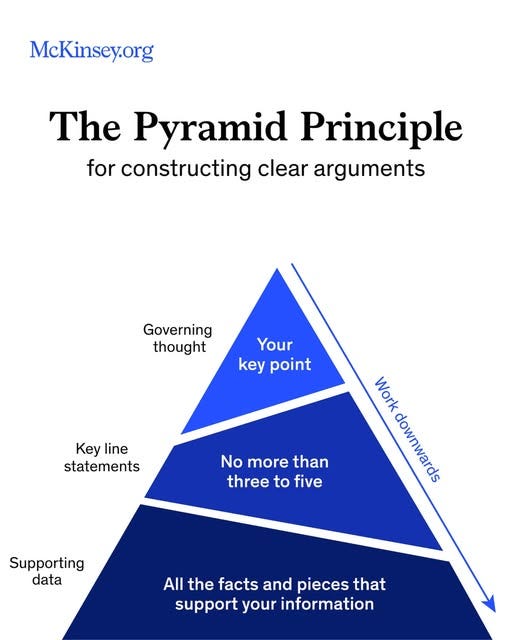
McKinsey draws the pyramid in three tiers and tells you to work from the top down. At the top is the governing thought, which is simply your key point. Below that are the key line statements, capped at three to five. The bottom tier is supporting data: every fact and piece of evidence that holds up the levels above.
In company messaging, the governing thought is your single overriding communications objective (SOCO), the one thing you want people to walk away with. McKinsey allows five key lines, but three works better for messaging, since three messages are much easier to remember than five. Each one can break into two or three supporting points, ideally with an example attached. Examples stick in people's heads much better than claims do, so give this bottom layer proper attention.
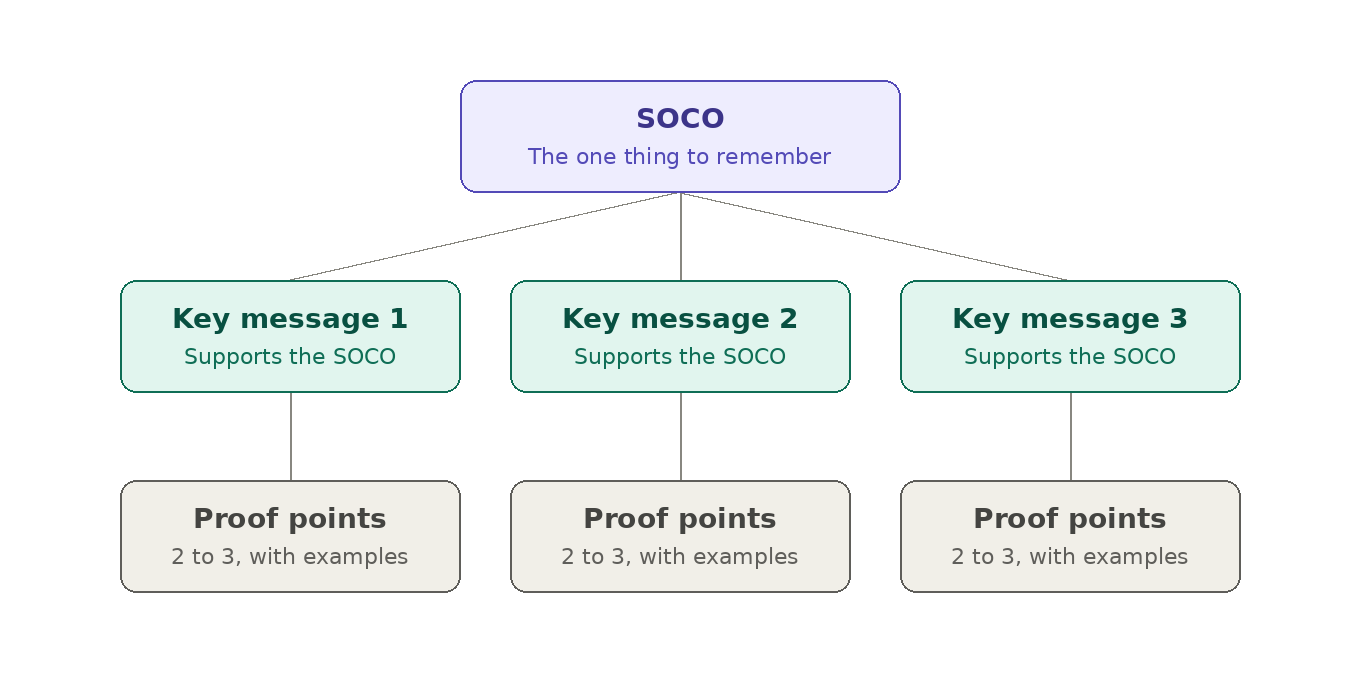
The finished result is a message house: one page that shows what the organisation says and how it all fits together.
Why bother
Put a report or presentation into a pyramid and the weak points show up straight away, because anything that doesn't support the objective has nowhere to go.
It also helps people remember the message, which is the whole point if you want staff to actually use a company narrative. The top messages stay fixed, and everyone can add examples from their own corner of the business.
Outside audiences get the same benefit. Investors care about different things from customers or regulators, so you rework the lower branches for each group and leave the top alone.
Consistency is where it earns its keep. When the CEO, the press office, investor relations and frontline staff are working from the same house, the company tells one story. People notice contradictions quickly, especially on sustainability, and they can hurt a company's reputation badly.
Getting started
You can do this on paper. Mind-mapping tools like MindManager, XMind or Coggle help if you want to share it. Write the SOCO, choose three supporting messages, then fill in the evidence. A branch with no good examples under it is usually a message that needs rethinking.
References
Minto, B. (1985) The Pyramid Principle: Logic in Writing and Thinking. Republished by Pearson, 1987.
Minto, B. (1996) The Minto Pyramid Principle: Logic in Writing, Thinking and Problem Solving. Expanded edition.
McKinsey & Company (n.d.) The Pyramid Principle for constructing clear arguments [graphic]. McKinsey.org.
McKinsey Alumni Center (n.d.) "Barbara Minto: 'MECE: I invented it, so I get to say how to pronounce it'". McKinsey & Company.
Dearnell, A. (2022) "Use the 'Pyramid Principle' to build your 'Message House'". Forbes, 13 October.