An open working library / 001—057
The DealRoom.
The Deal Room is a collection of resources you can use to build, qualify and close pipeline effectively and consistently
“If you can’t explain it simply, you don’t understand it well enough.”
— Albert Einstein
“Don’t find customers for your products, find products for your customers.”
— Seth Godin
01 / The collection
Find your next edge.
Good ideas travel. Browse the people, reading and practical thinking worth keeping close.
Books and blogs
16Kellblog by the one and only Dave Kellog
Kellblog (opens in a new tab) Dave Kellogg is an EIR at Balderton Cap. This is a GTM leader essential bookmark. Kellblog covers topics related to starting, leading, and scaling enterprise software startups including strategy, marketing, positioning, messaging, management, go-to-market, SaaS metrics, and venture capital financing. Ten years’ experience in each of the CEO, CMO, and independent director roles in companies from zero to over $1B in revenues.
John McMahon, The qualified sales leader
The Qualified Sales Leader: Proven Lessons from a Five Time CRO (opens in a new tab) Top 5 Takeaways from Our Conversation with John McMahon (opens in a new tab)
Five-time CRO John McMahon’s book, The Qualified Sales Leader: Proven Lessons from a Five Time CRO (opens in a new tab), has been at the top of sales leaders’ reading lists since it was published in April. McMahon recently joined John Kaplan on The Audible-Ready Sales podcast to discuss the book’s themes and key takeaways for sales leaders. Listen to their conversation here (opens in a new tab). Here are our top five takeaways from the conversation.
Partner Hacker
Partner Hacker book (opens in a new tab) What’s your go to book for all things partnerships? Do you have one? Neither did I. There are a few good books on partnerships and mainly ‘channel’ from the naughties and teens but these focus on massive company OEM and resale programmes or consumer products. Nothing allowed me to dive into my narrative I was seeing the market, of building synergistic partnerships in the eco-system, building up co-marketing, sales team collaborations and the tools, processes and expertise that was missing in what we at CaptionHub were doing since year 1. This is a super quick read, really handy and has some great tips and tricks. Like getting to your partners sumo question
Tomas Tungzt: venture capitalist at Theory
Tomasz Tunguz by @ttunguz (opens in a new tab)
Tomasz is a General Partner at Theory Ventures, a $235m early stage venture capital firm. He blogs sat tomtunguz.com & co-authored Winning with Data. his blog is a seminal resource for everything growth and venture in data.
The Force Management blog
https://www.forcemanagement.com/blog (opens in a new tab) John Kaplan and Grant Wilson have built Charlotte- based Force Management into one of the top sales transformation providers in the nation, with a reputation forged on quality and delivering measurable results of the nation's leading Sales Training and Enablement providers.
TL;DR AI market movers and roundup
Ok, shameless plug alert: https://jamesonjames.substack.com/ (opens in a new tab)
Crossing the chasm by Geoffrey Moore
The cold start problem by Andrew Chen
Product-led growth by Wes Bush
From impossible to inevitable by Aaron Ross & Jason Lemkin
The sales acceleration formula by Mark Roberge
Zero to one by Peter Thiel
Play bigger by Al Ramadan
Founding sales by Pete Kazanjy
Lenny's Newsletter
Growth Unhinged by Kyle Poyar
Sales and market positioning leaders
05Mark Cranney
https://x.com/mdcranney (opens in a new tab) The man who brought PTC sales triumph to A16Z. Mark was the former Chief Operating Officer at Skydio where he transformed the company from a pure-play direct-to-consumer company to an enterprise and public sector business. Cranney built out and led all three businesses including finance, supply chain, operations, and go-to-market functions leading the company to unicorn valuation status. Prior to joining Skydio, Cranney was COO at Signalfx that was acquired by Splunk for $1.05B a16z blogs/podcasts from Mark are here: https://a16z.com/author/mark-cranney/ (opens in a new tab)
John McMahon
https://x.com/mcmahon_john (opens in a new tab) Former CRO at multiple startup companies that evolved into CRO at 5 public software companies (PTC, GeoTel, Ariba, Bladelogic, BMC). Currently, a board member at: MongoDB, Sigma and Observe.
Author of : The Qualified Sales Leader
Aaron Ross
Mark Roberge - former HubSpot CRO
Tiffani Bova - Salesforce, growth strategies
Product led growth leaders
04Hila Qu - GitLab/Deepgram (+nx)
Wes Bush - ProductLed
Elena Verna (Lovable)
Kyle Poyar - OpenView, Growth Unhinged
SaaS/AI thought leaders
08Dave Kellogg
https://x.com/kellblog (opens in a new tab) EIR at Balderton Capital (opens in a new tab) and ten years’ experience in each of the CEO, CMO, and independent director roles in companies from zero to over $1B in revenues.
Tomasz Tunguz
https://x.com/ttunguz (opens in a new tab) Venture capitalist and Managing Director at Theory Ventures, known for data-driven insights into SaaS growth, capital efficiency, and go-to-market strategy. Formerly at Redpoint Ventures and a Java eng Xoogler. Through his widely read blog, Tunguz distils complex topics such as pricing models, churn dynamics, and sales efficiency — into practical frameworks for founders and GTM leaders. His work is particularly relevant to go-to-market teams seeking to balance growth with efficiency, structure predictable revenue engines, and align product-market fit with scalable sales motions.
Sammy Abdullah
www.linkedin.com (opens in a new tab) https://blossomstreetventures.medium.com/ (opens in a new tab)
Sammy, Blossom Street Ventures is one of my industry go to people. His data and analysis is always sharp and on point. It’s more focused on venture and scale than actual GTM but all the same is a really important lense for me and should be for any strategic leader in the market.
Jason Lemkin - SaaStr
Clement Delangue - Hugging Face CEO
Sarah Wang - a16z partner
Patrick Campbell - ProfitWell/Paddle
Christoph Janz - Point Nine Capital
Articles
14The guide to becoming a GTM engineer (me, Nextplay)
https://nextplayso.substack.com/p/the-guide-to-becoming-a-gtm-engineer (opens in a new tab)
GTM (Go-To-Market) Engineers are emerging as a key startup role focused on building AI-powered systems that drive revenue. Using tools like Clay, they automate processes like lead generation, outreach, and sales ops—work that once took whole teams. The role blends tech, growth, and creativity, and is in growing demand. To become one:
- Learn tools by solving real problems
- Build systems that prove you can generate revenue
- Pitch companies with clear, tailored value Core skills: systems thinking, automation and AI tool fluency, light/medium coding, and strong communication skills – this sits at in GTM but interfaces with engineering, and possibly other technical functions.
Product-led growth: what it is and why it's here to stay (OpenView Venture Capital)
The hierarchy of engagement: the fuel to build an enduring, billion dollar business (Sarah Tavel)
AI’s $200B question (Sequoia)
SPICED vs MEDDIC (Winning by Design)
MEDDIC and SPICED 2023 - Two Different Approaches - Winning by Design (opens in a new tab)
We recommend those who have invested in MEDDIC and have achieved adoption within the team to continue their investment. instead contemplate to integrate MEDDIC and SPICED. For the same reason you should not stop a marketing campaign, an email newsletter, or use of a CRM for that matter. SPICED is a methodology that goes across the entire customer journey, and its focus is to integrate different methodologies so they speak the same language and are interoperable with each other.
SPICED used in Deal Qualification
One of the most commonly used methodologies in the sales process is MEDDIC. MEDDIC is the epitome of a departmental function, in that it is only applied in sales, and primarily used by sales professionals. It’s like the Lightsaber of the older generation. So, can we make MEDDIC interoperable with SPICED?
Applying MEDDIC to SaaS using SPICED
MEDDIC is a stage-based deal qualification methodology. It is particularly effective in complex sales environments where multiple stakeholders are involved. It emphasizes understanding the buyer’s needs, decision-making process, and key players within the organization. By addressing these critical aspects, sales teams can increase their chances of winning deals and minimize the risk of losing opportunities due to misunderstandings or misalignment. MEDDIC is an acronym that stands for: (M) Metrics: Understanding the buyer’s specific metrics and Key Performance Indicators (KPIs) they must achieve. (E) Economic Buyer: Identifying and engaging with the person with the authority to make purchasing decisions. (D) Decision Criteria: Understanding the specific criteria the buyer will use to decide. (D) Decision Process: Knowing the steps and timeline involved in the buyer’s decision-making process. (I) Identify Pain: Uncovering the buyer’s challenges, problems, or pain points. (C) Champion: Finding a champion or internal advocate within the buyer’s organization. Whereas MEDDIC (and its derivatives) tells you where to pay attention, the SPICED approach’s framework reveals how to extract the information MEDDIC needs. What we are going to do next is demonstrate this by making MEDDIC interoperable with SPICED.
Step 1. Identify Pain and Metrics using the Impact Diagnosis Framework:
Identifying the metrics, as in the Impact your solution brings to the customer. The Impact-based framework 8.2.2 provides a 2-dimensional view of “How to Uncover Impact” and “Identify Pain.” It allows managers to leverage their investment in MEDDIC and expand that with a “and here is how you can” – from Knowledge to Know-how.
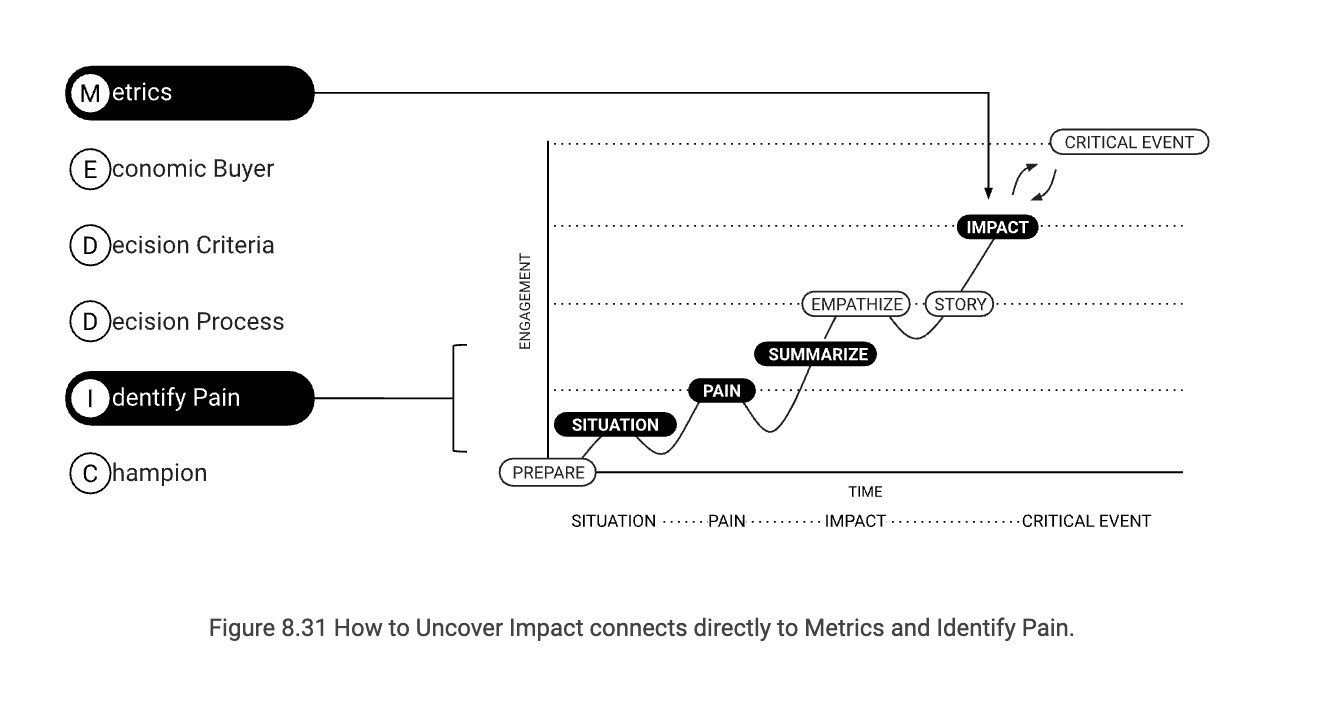 Whereas MEDDIC only looks for the rational impact, it shows you that through SPICED it also offers you emotional impact. It is amazing how robust MEDDIC still is 25 years after its conception.
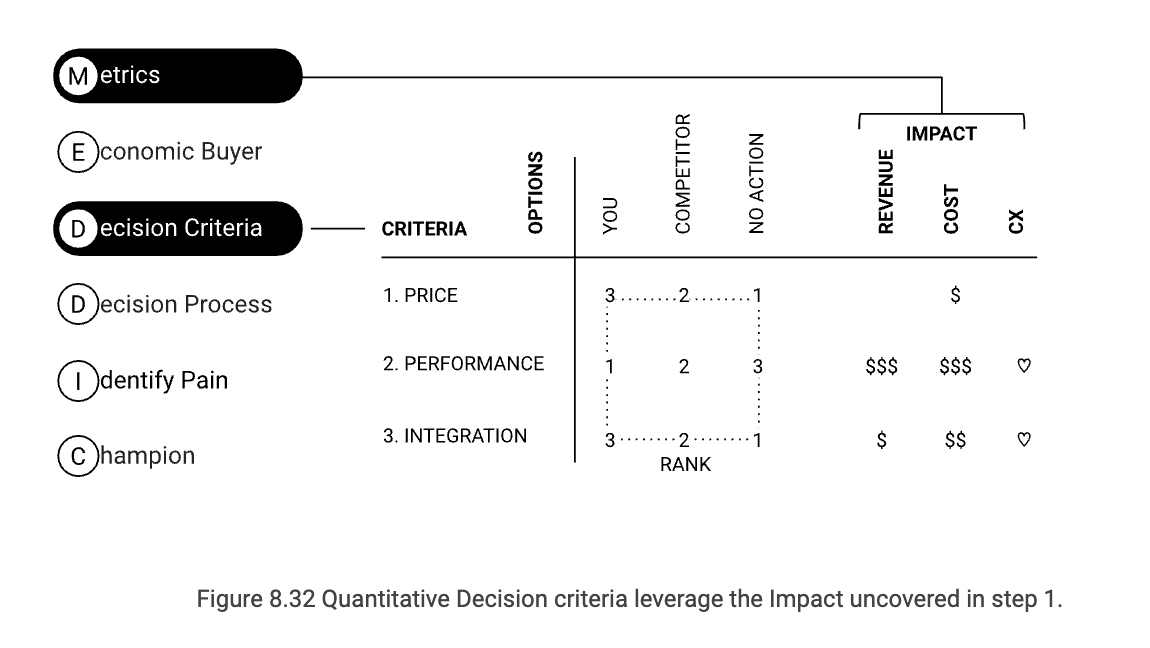
Step 2. Determine the Decision Criteria using Impact.
Once we have identified the Impact, we can make it part of the Decision Criteria, in which we help customers establish the rational Impact so they can communicate with their stakeholders using a quantitative approach.
Step 3. Determine the Decision Process using SPICED
Historically, MEDDIC was used for perpetual software sales, priced in the millions of dollars, explaining the focus on getting consensus across a wide variety of decision-makers involved in the Decision process. Combining MEDDIC with the role of a buying center provides a roadmap that allows managers to tell what needs to happen and how to do it. For example, many sales managers have tasked their sales reps over time to “get to the decision-maker (decider).” With SPICED, we have learned that a champion is triggered by Impact and a decider by the date they need that Impact (Critical Event).
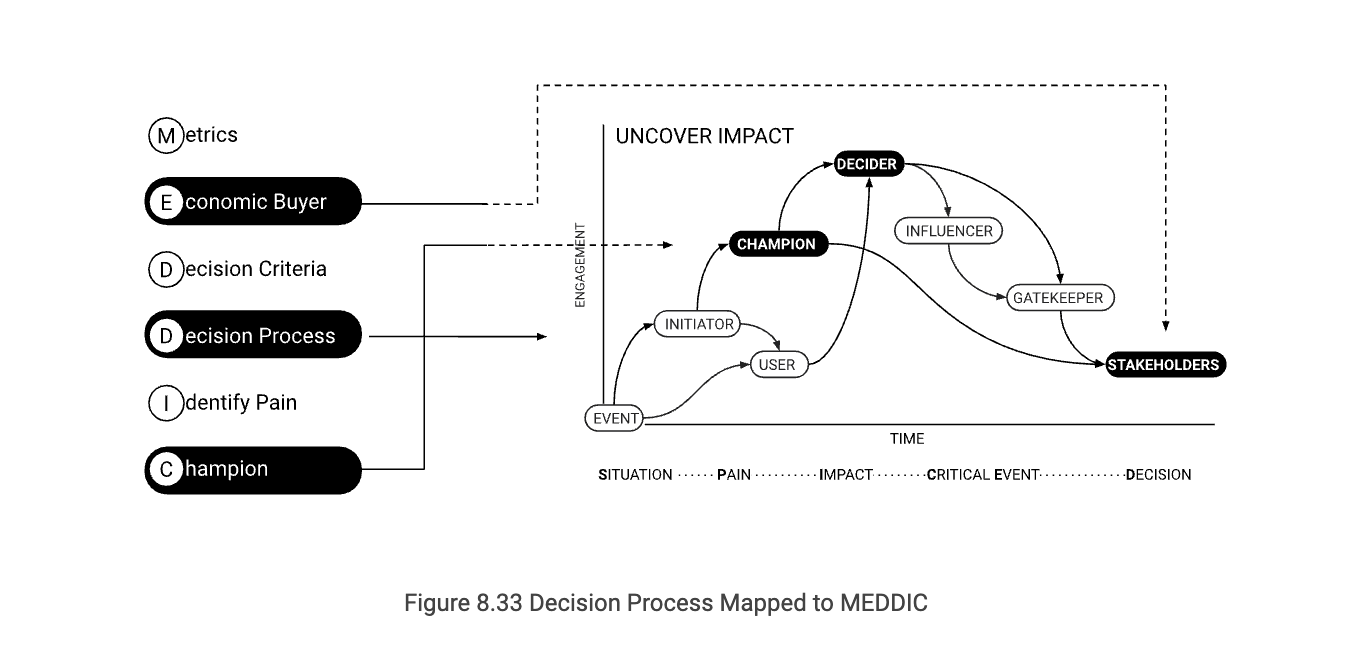 What is common across these three steps is that MEDDIC explains what needs to happen, and SPICED; SPICED does this by connecting all elements of MEDDIC to impact, creating a common connection between all elements of SPICED but, more importantly, building a bridge to marketing campaigns and customer success functions. SPICED gives an idea of how to make this happen and translates this to operational actions.
A comparison MEDDIC vs. SPICED
We get asked all the time what is the main difference between MEDDIC vs. SPICED, they are two very different approaches.
Comparison of SPICED and MEDDIC
| Aspect | SPICED | MEDDIC |
|---|---|---|
| Origins | By WbD Established in 2012 for SaaS businesses. | Established in 1996 for Perpetual Software Sales. |
| Business Model | Subscription-based model. | Ownership-based model. |
| Metrics | Based on the full customer journey | Based on the sales funnel |
| Forecasting | Based on actions | Based on stages |
| Organization | Sales; Marketing; Customer Success; Product Management | Sales |
| Sales Motions | Dedicated touch.(Strategic Accounts); High-Touch (Enterprise); Mid-Touch (SMB); Low-Touch (Groups); No Touch (Pro-users) | Dedicated touch.(Strategic Accounts); High-Touch (Enterprise) |
| Target Audience | Seller with 5+ years of experience. | Seller with 20+ years of experience. |
| Action vs. Direction | Action Driven: Provides a how-to approach, giving actionable insights. | Direction Driven; tells you what needs to be done next. |
| Cross-Functional Communication | Uniform methodology for cross- departmental communication | Used to improve forecasting, ; inter-departmental communication. |
| Integrated Sales Methodology | High velocity sellingProvocative sellingConsultative sellingSolution sellingTransactional | Consultative selling |
| Supported roles in the Buyer Center | User; Initiator; Champion; Decider; Gatekeeper; Influencer; Stakeholders | Champion; Decider. |
| Primary Focus | Customer-centric; Focus on establishing impact. | Seller-centric; Aimed at closing deals. |
| Focus Area | Centers on Priority, and RoI..In SaaS every deal has a 10-100x RoI. | Centers on RoI. |
| Set Theory Terms | SPICED has additional elements that cannot be found in MEDDIC. | All elements of MEDDIC can be found within the SPICED methodology. |
| Example | SPICED is used to target the right customer. During the sales process, it focuses on how to identify impact using question-based techniques and determines how this affects the decision criteria. It helps identify who is involved in the decision process. It can use a solution architect to help set a priority for the service against other SaaS purchases. Once a decision is made, it facilitates a seamless transition to the customer success team to pursue impact. | MEDDIC is used by the manager to check if a seller has performed an action. It relies on the seller to find a satisfactory answer, centered on RoI. It focuses on competitive advantages. It works closely with a sales engineer to provide a turn-key solution to the customer. |
Here’s a comparison between SPICED and MEDDIC, focusing on their efficacy in B2B software sales.
SPICED
Framework Components: S: Situation: Current context where the prospect operates. P: Pain: Problems or challenges faced by the prospect. I: Impact: Emotional and rational consequences. C: Critical Event: Time-sensitive triggers. D: Decision: Decision-making process and criteria. Methodology:
- Utilizes question-based selling during the discovery process.
- Incorporates storytelling where the “hero” is a person at the customer’s organization.
- Focuses strongly on both rational and emotional “Impact.” Strengths in B2B Software Sales:
- Emotional storytelling and question-based selling make it highly adaptable and customer-centric.
- Capable of capturing a more holistic understanding of the customer.
- Well-suited for solutions where differentiation is crucial, even in crowded markets.
MEDDIC
Framework Components: M: Metrics: Quantifiable economic benefits. E: Economic Buyer: Person who controls the budget. D: Decision Criteria: Standards for evaluating solutions. D: Decision Process: Organizational procedure for buying. I: Identify Pain: Business challenges needing resolution. C: Champion: Advocate within the customer organization. Methodology:
- More structured and metrics-driven.
- Typically does not integrate storytelling as a core component (though it could be adapted to include it). Strengths in B2B Software Sales:
- Strong in environments where quantitative ROI is a primary concern.
- Ideal for complex sales involving multiple stakeholders.
- Often used in longer sales cycles and high-value deals.
Comparing the Two in B2B Software Sales:
- Depth of Understanding: SPICED’s question-based selling may provide a more comprehensive view of individual motivations. MEDDIC, on the other hand, excels at understanding organizational structures and metrics.
- Emotional Connection: SPICED explicitly focuses on emotional impact and incorporates it into storytelling, making it more engaging on a personal level. MEDDIC is more data-driven and may not explicitly account for emotional factors.
- Sales Cycle and Complexity: MEDDIC often shines in complex, long-cycle sales typical of large enterprise solutions. SPICED can be more agile and better suited for shorter cycles or less complex solutions.
- Decision-Making: Both frameworks address the decision-making process but from different angles. SPICED delves into emotional and rational impacts affecting the decision, while MEDDIC focuses on criteria and processes.
- Customer-Centric vs. Process-Centric: SPICED, with its storytelling and question-based methodology, can create a more customer-centric experience. MEDDIC tends to be more process-centric, focusing on the systematic progression of a sale through an organization. The choice between SPICED and MEDDIC may depend on your specific sales environment, the complexity of your product, and the emotional vs. rational drivers you find most effective for engaging your prospects. Both frameworks have merits; understanding their distinct advantages can help you tailor your sales strategy accordingly.
Sales-led vs product-led vs hybrid: choosing the right GTM motion
Few decisions shape a B2B SaaS company more than its go-to-market motion. It determines who you hire, how you price, what you build and how fast you can grow. Yet many companies choose a motion based on trends rather than fit.
The three motions
Sales-led growth (SLG): Revenue comes primarily through a sales team running discovery, demos and negotiation. Common for complex, high-value products.
Product-led growth (PLG): The product itself drives acquisition, conversion and expansion, usually through a free trial or freemium tier.
Hybrid: A self-serve entry point feeds a sales team that focuses on larger accounts and expansion.
Three factors that decide the fit
1. Annual contract value (ACV)
Low ACVs cannot support the cost of a full sales cycle. High ACVs usually justify, and often require, human involvement.
2. Buyer complexity
If a purchase involves IT, security, legal and finance sign-off, a sales team is needed to coordinate it. If a single user can adopt the product and see value alone, PLG becomes realistic.
3. Time to value
PLG depends on users reaching an "aha moment" quickly and without help. If meaningful value requires integration, data migration or configuration, a self-serve model will struggle.
A simple decision guide
| Factor | Points to PLG | Points to SLG |
|---|---|---|
| ACV | Low | High |
| Buyers | Single user or team | Committee |
| Time to value | Minutes or hours | Weeks |
| Onboarding | Self-serve | Guided |
If your answers split across both columns, a hybrid model is likely the right choice.
Common pitfalls
- Adding PLG as a feature: A free trial on a product that needs onboarding produces sign-ups that never convert.
- Adding sales too late: PLG companies often wait too long to put sales in front of high-usage accounts.
- Running two motions without clear rules: Hybrid models need defined handoff criteria, such as usage thresholds or company size.
Conclusion
The right motion follows from your product and your buyer. Start with ACV, buyer complexity and time to value, and let those guide the model rather than the latest growth playbook.
Pipeline coverage ratios: what 3x actually means
"We need 3x pipeline coverage" is one of the most repeated rules in B2B sales. It is also one of the most misunderstood. Used blindly, it can leave teams either overconfident or chasing pipeline they don't need.
What pipeline coverage measures
Pipeline coverage is the value of open pipeline divided by the revenue target for a period.
Example: A £500k quarterly target with £1.5m of qualified pipeline gives 3x coverage.
Where the 3x rule comes from
The 3x benchmark assumes a win rate of roughly 33%. If one in three opportunities closes, you need three times your target in pipeline to hit it.
Why 3x often breaks down
Your win rate may be different
If your win rate is 20%, 3x coverage leaves you well short. If it is 45%, 3x may be more than you need.
Not all pipeline is equal
A deal created last week and one sitting in negotiation are counted the same way in a simple coverage ratio, even though their chances of closing are very different.
Timing matters
Pipeline that won't close until next quarter inflates coverage for this one.
Pipeline hygiene
Stale deals that should have been closed-lost make coverage look healthier than it is.
How to set your own ratio
- Calculate your true win rate from the last four to six quarters, by segment if possible.
- Divide 1 by your win rate to get your baseline ratio. A 25% win rate means 4x.
- Adjust for slippage – if 20% of deals typically move to the next quarter, increase the ratio accordingly.
- Use stage-weighted pipeline alongside the raw ratio for a more realistic view.
- Clean the pipeline before measuring coverage.
Conclusion
Pipeline coverage is a useful early warning signal, but only when the ratio reflects your own data. Replace the 3x rule of thumb with a number built from your win rates, cycle times and slippage.
Account-based marketing on a small budget
Account-based marketing (ABM) is often associated with expensive platforms, intent data subscriptions and large teams. But the core idea – focusing effort on a defined set of high-value accounts – works just as well for a team of two or three.
Start with a short list
The biggest advantage of a small team is focus. Rather than targeting hundreds of accounts, choose 20 to 50 that closely match your ICP.
Selection criteria:
- Fit with your best existing customers
- A clear trigger, such as new funding, a leadership change or rapid hiring
- Existing relationships or warm connections
Map the buying committee
For each account, identify the three to five people most likely to be involved in a decision. LinkedIn Sales Navigator, company websites and your CRM usually provide enough to start.
Tier your accounts
| Tier | Accounts | Approach |
|---|---|---|
| Tier 1 | 5–10 | Fully personalised research, content and outreach |
| Tier 2 | 10–20 | Personalised by industry or use case |
| Tier 3 | 20–30 | Light personalisation, targeted ads |
Low-cost tactics that work
- Personalised outreach sequences written jointly by marketing and sales
- LinkedIn matched audiences to keep your brand in front of target contacts
- Account-specific content, such as a short benchmark or teardown relevant to their business
- Small, targeted events like roundtables or dinners for Tier 1 accounts
- Direct mail for a handful of high-priority contacts
Align with sales from day one
ABM only works if sales is fully involved. Agree the target list together, meet weekly to review engagement and share notes on every account.
Measure what matters
Traditional lead metrics don't fit ABM. Instead, track:
- Engagement across the buying committee
- Meetings booked with target accounts
- Opportunities created and pipeline value
- Deal velocity compared with non-ABM deals
Conclusion
ABM is a strategy, not a software category. With a focused account list, close sales alignment and a few well-chosen tactics, a small team can run an effective programme without a large budget.
Pricing is a GTM decision, not a finance decision
In many B2B SaaS companies, pricing is set by finance or the founders and then handed to sales and marketing to execute. But pricing and packaging shape almost every part of go-to-market – from who you target to how deals are run.
How pricing shapes GTM
Who you can sell to
A starting price of £50k a year rules out small businesses, whatever your marketing says. A £20-per-user plan makes enterprise procurement unnecessary for small teams.
How you sell
Low entry prices support self-serve and product-led motions. High prices require a sales team, a longer cycle and a formal buying process.
How you expand
Usage-based or seat-based pricing creates natural expansion paths. Flat pricing limits net revenue retention unless you add new products.
How you compete
Packaging determines which competitors you are compared with and which features buyers see as standard.
Signs your pricing is working against your GTM
- Deals stall on price in late stages, suggesting value isn't established early enough or packaging doesn't match buyer needs
- Heavy discounting has become the norm to close deals
- Customers buy the lowest tier and never upgrade
- Sales and marketing target different segments from those the pricing was designed for
Bringing GTM into pricing decisions
- Include sales, marketing and customer success in pricing reviews
- Use win/loss data to understand where price is a real objection
- Align packaging with ICP segments, so each tier maps to a buyer profile
- Choose a value metric that grows as customers get more value
- Test changes on new customers first before rolling them out to the base
Conclusion
Pricing is one of the most powerful GTM levers a SaaS company has. Treating it as a shared decision between finance and go-to-market teams leads to better-fit customers, smoother deals and stronger expansion.
Shortening the enterprise sales cycle
Enterprise deals are slow by nature. Multiple stakeholders, security reviews, legal negotiation and budget cycles all add time. But much of the delay in a typical enterprise deal is avoidable.
Where time is lost
- Late discovery of stakeholders, such as a security or procurement team that appears after the business case is agreed
- Weak champions who like the product but cannot drive a decision internally
- Unclear next steps that let momentum fade between meetings
- Procurement surprises, including security questionnaires, DPAs and vendor onboarding
1. Use mutual action plans
A mutual action plan (MAP) is a shared timeline, agreed with the buyer, that lists every step to a signed contract.
A good MAP includes:
- Key milestones and owners on both sides
- Target dates working back from the buyer's go-live date
- Legal, security and procurement steps
- Decision criteria and sign-off requirements
MAPs make hidden steps visible early and give your champion a tool to manage the process internally.
2. Build stronger champions
A true champion has influence, access to the economic buyer and a personal reason to see the project succeed.
How to test a champion:
- Can they get you a meeting with the economic buyer?
- Will they share internal information about budget and competing priorities?
- Are they willing to present the business case themselves?
Equip them with a business case, ROI summary and answers to likely objections.
3. Prepare for procurement early
Don't wait for the buyer to raise procurement. Have ready:
- Completed standard security questionnaires
- Security documentation and certifications
- A standard DPA and contract terms
- Clear pricing and approved discount ranges
Raise procurement in the first few meetings and ask what their process involves.
4. Multi-thread from the start
Relying on a single contact is one of the biggest risks in enterprise sales. Build relationships across the buying committee early so the deal survives if your champion leaves or loses influence.
Conclusion
Enterprise sales cycles will never be fast, but they can be predictable. Mutual action plans, strong champions, early procurement preparation and multi-threading remove much of the avoidable delay.
Net revenue retention as a GTM metric
For years, go-to-market in B2B SaaS focused almost entirely on new logos. Today, net revenue retention (NRR) is recognised as one of the most important indicators of long-term growth – and it belongs at the centre of the GTM plan.
What NRR measures
NRR shows how much recurring revenue you keep and grow from existing customers over a period, including expansion, contraction and churn.
Formula: NRR = (Starting ARR + Expansion – Contraction – Churn) ÷ Starting ARR
Example: Starting ARR of £1m, £200k expansion, £50k contraction and £80k churn gives NRR of 107%.
An NRR above 100% means your existing customer base grows even without new sales.
Why NRR belongs in the GTM plan
It reduces dependence on new business
Strong NRR lowers the pressure on acquisition to hit growth targets.
It reveals ICP quality
Customers who churn quickly or never expand are often a sign of poor fit – feedback that should shape targeting.
It improves unit economics
Expansion revenue typically costs far less to acquire than new logo revenue, improving CAC payback.
How to make NRR part of GTM
- Set an NRR target alongside new business targets in the annual plan
- Give customer success a revenue number, not just health scores
- Share churn and expansion data with marketing and sales to refine the ICP
- Define clear ownership for renewals and expansion between CS and account management
- Build expansion into pricing and packaging, with a value metric that grows with usage
Leading indicators to watch
- Product usage and adoption trends
- Number of active users per account
- Executive sponsor engagement
- Support ticket volume and sentiment
Conclusion
New logos build the base, but retention and expansion determine how efficiently a SaaS business grows. Putting NRR into the GTM plan aligns every team around the full customer lifecycle.
Designing expansion plays that don't feel like upselling
Expansion revenue is one of the most efficient sources of growth in B2B SaaS. But poorly timed or generic upsell attempts can damage trust and even increase churn. The best expansion plays feel like help, not a sales pitch.
Why traditional upselling fails
- Timing is based on the renewal date, not the customer's needs
- Offers are generic, ignoring how the customer actually uses the product
- The ask comes before value is proven on the current plan
Three triggers for well-timed expansion
1. Usage triggers
When a customer approaches a plan limit or uses a feature heavily, expansion becomes a natural conversation.
Examples:
- Reaching 80% of a usage allowance
- Heavy use of a feature that is limited on their current tier
- Repeated attempts to access a premium feature
2. Seat growth
New users joining, or requests for access from other departments, signal that the product is spreading internally.
Examples:
- A spike in invited users
- Sign-ups from new email domains or teams within the same company
- Admin requests for additional licences
3. Business events
Changes in the customer's business can create new needs.
Examples:
- Funding rounds or acquisitions
- New leadership in a relevant function
- Expansion into new markets or regions
Principles for good expansion plays
- Lead with the customer's outcome, not your product tier
- Use data to personalise the conversation around actual usage
- Make the next step easy, ideally with self-serve upgrades for smaller changes
- Coordinate CS and sales so customers aren't contacted by multiple people
- Review results regularly to see which triggers lead to conversions
Conclusion
Expansion works best when it responds to what customers are already doing. By building plays around usage, seat growth and business events, SaaS teams can grow accounts in a way that customers welcome.
RevOps for scale-ups: the minimum viable stack
As SaaS companies grow, the temptation is to solve every problem with a new tool. The result is often a bloated tech stack, disconnected data and a RevOps team that spends more time on integrations than insight. Scale-ups need a minimum viable stack first.
The principle
Every tool should solve a clear problem, have an owner and connect to a single source of truth. If it doesn't, it probably isn't needed yet.
The core layers
1. CRM – the source of truth
Your CRM should hold accounts, contacts, opportunities and activity. Everything else should feed into it.
Priorities:
- Clean, consistent opportunity stages
- Required fields for key data such as source, ACV and close date
- Clear ownership rules for accounts and leads
2. Marketing automation
Handles email, forms, lead scoring and campaign tracking, integrated with the CRM.
3. Sales engagement
Supports outbound sequences and activity tracking. For small teams, CRM-native features may be enough.
4. Reporting and forecasting
Start with CRM dashboards and a well-built spreadsheet model before investing in a dedicated forecasting platform.
5. Billing and subscription data
Connecting billing to the CRM gives a full view of ARR, expansion and churn.
What can usually wait
- Dedicated intent data platforms
- Conversation intelligence tools
- Advanced attribution software
- Separate customer success platforms, until CS has scale
Signs you need to add a tool
- A manual process is taking hours each week
- A clear business problem can't be solved with existing tools
- The team has capacity to implement and maintain it
- The data it produces will be used in decisions
Common mistakes
- Buying tools before defining processes
- Letting each team choose its own tools without integration planning
- Ignoring data hygiene, which undermines every tool in the stack
Conclusion
A lean, well-integrated stack beats a large, disconnected one. Build the foundations – CRM, marketing automation, sales engagement, reporting and billing – and add more only when a clear need appears.
How AI agents are reshaping the SDR role
The sales development representative (SDR) role has long been the entry point into B2B sales. With AI agents now capable of researching accounts, writing personalised outreach and handling early responses, the role is changing fast.
What AI is automating
Account and contact research
AI tools can summarise company news, hiring trends, tech stack and funding in seconds, replacing hours of manual research.
Personalised first drafts
AI can write tailored emails and LinkedIn messages based on research and ICP data.
List building and enrichment
Finding contacts, verifying emails and enriching CRM records are increasingly automated.
Inbound response and qualification
AI agents can respond to inbound enquiries, answer basic questions and book meetings around the clock.
What still needs humans
Judgement on target accounts
Deciding which accounts deserve focus, and why now, still benefits from human context and business understanding.
Real conversations
Cold calls, objection handling and discovery conversations rely on listening, empathy and adapting in real time.
Relationship building
Building trust with senior buyers over time remains a human skill.
Quality control
AI-generated outreach at scale can damage brand reputation if nobody reviews tone, accuracy and relevance.
How the SDR role is evolving
- From volume to quality: fewer, better-researched touches rather than high-volume sequences
- From manual research to orchestration: managing AI tools and workflows
- From scripts to conversations: more time spent on live calls and discovery
- Closer to marketing and RevOps: working with signals, data and campaigns
What leaders should do
- Audit SDR time to see which tasks can be automated
- Redefine the role around higher-value activities
- Set quality standards for AI-generated outreach
- Update metrics to focus on meetings and pipeline, not activity volume
- Invest in training on discovery, AI tools and business acumen
Conclusion
AI won't eliminate the SDR role, but it will transform it. The SDRs – and sales leaders – who adapt fastest will spend less time on repetitive tasks and more on the conversations that create pipeline.
Videos and podcasts
05Acquired
Acquired (opens in a new tab) https://open.spotify.com/show/7Fj0XEuUQLUqoMZQdsLXqp (opens in a new tab)
https://www.acquired.fm/episodes/google (opens in a new tab)
Acquired is not necessarily a pure GTM podcast in the classic sales sense. It is about business and scale and the thorough research and deep insights provided are a must listen for anyone thinking about global scale. Episodes prioritise depth and are better described as "conversational audiobooks" than "podcasts." Episodes can feature guests, such as the founders/CEOs of NVIDIA, Berkshire Hathaway, Starbucks, Meta, Spotify, TSMC, and CAA.
The official SaaStr podcast
The Official SaaStr Podcast: SaaS | Founders | Investors (opens in a new tab) The Official Saastr Podcast (opens in a new tab) https://www.saastr.com/podcasts/ (opens in a new tab)
The Official SaaStr Podcast is the latest and greatest from Jason Lemkin’s SaaStr. Honest, to the point, no fluff. Interviewing prominent operators and investors to discover tips, tactics and strategies to attain success in the fiercely competitive world of SaaS. Getting from $0 to $100m ARR faster, what it takes to scale successfully and what the core elements of hiring. For the investors, we learn what metrics they hone in on when examining SaaS business, what type of metrics excites them and what they look for in SaaS founders.
The RevOps podcast
RevOps Podcast (opens in a new tab) RevOps Podcast (opens in a new tab) RevOps Podcast | Revenue (opens in a new tab)
A marketing punt from revenue.io; but there aren’t many rev ops focused forums out there, and good rev ops can really accelerate growth, so here you go. Howard Brown (Founder & CEO, Revenue.io (opens in a new tab)) and Alastair Woolcock (Chief Strategy Officer, Revenue.io (opens in a new tab)) and the world’s top revenue leaders to explore the critical insights, technologies, strategies and psychology behind RevOps and revenue science.
Revenue builders (Force Management)
https://open.spotify.com/show/7K8z02ezDUy6kXqAUAyZvo (opens in a new tab) Revenue Builders (opens in a new tab)
A weekly show featuring B2B sales leaders and executives. Hosted by Five-time CRO John McMahon and Force Management’s Co-Founder John Kaplan, the show goes in the barrel, behind the scenes with the people who have been there, done that and seen the results. Revenue Builders covers the best practices for scaling and growing your business, while sharing the pitfalls to avoid. Great conversation. Solid interviews. Tangible takeaways to help you succeed. If you enjoy our content, please subscribe, rate and review the show to help us reach more people.
The Run revenue show (Clari)
The Run Revenue Show (opens in a new tab) https://podcasts.apple.com/us/podcast/the-run-revenue-show/id1675136765 (opens in a new tab)
The number one enemy of every sales team is revenue leak. As a sales leader…what are you doing to beat it? Behind-the-scenes access to executive conversations with the best revenue pros in the world, and get their tips, strategies, and real-life stories for how they stop revenue leak, achieve revenue precision, and lead their teams to success.
Training and consultancy
05Force Management
MEDDICC Sales Qualification Methodology & Process | Force Management (opens in a new tab) Ascender - Accelerate Sales Performance | Force Management (opens in a new tab) John Kaplan and Grant Wilson built Charlotte- based Force Management (opens in a new tab) into one of the top sales transformation providers in the nation, with a reputation forged on quality and delivering measurable results of the nation’s leading Sales Training and Enablement providers. They offer class / room based training from around $20,000 and their online e-learning, Ascender for MEDDICC and bunch of other courses that are important foundations for sales team training.
Winning by Design
Course - Selling into Enterprise Accounts - Winning by Design (opens in a new tab) Design, build and operate a scalable and sustainable recurring revenue business with this top-tier sales team training for enterprise recurring revenue businesses.
Reforge - growth, marketing, GTM course
ProductLed Academy - Wes Bush's PLG certification
Pavilion (formerly Revenue Collective)
02 / The practical kit
Tools & templates.
The working stack, useful references and a few documents worth reaching for when the theory becomes the job.
the JD we used to hire our first killer GTM engineer
03 / A reminder
Revenue is vanity, profit is sanity, cash is king … but retention really does matter, so measure what matters!
04 / Working vocabulary
Keep the language clear.
9 terms to keep close
- NRR
- Net Revenue Retention (NRR) = expansion and retention
- GRR
- Gross Revenue Retention (GRR) = starting Revenue - Revenue Lost from Churn/Downgrades) / Starting Revenue
- PQLs
- Product (Partner can be used here too) Qualified Leads (PQLs) = users ready for sales
- SQLs
- Sales Qualifies Leads (SQLs) = leads qualified and usually created by sales
- PQAs
- Product (Partner can be used here too) Qualified Accounts (PQAs) = accounts showing buying signals
- TTA
- Time to Activation (TTA) = speed to first activation point
- TTV
- Time to (First Demonstrated) Value (TTV) = speed to first value
- CAC Payback
- CAC Payback Period = capital efficiency
- ARR Mix
- PaLG vs PLG vs Sales-Led ARR Mix = revenue mix matters